
.svg)

.svg)

Clear visibility helps marketing teams stay aligned and move faster.
Most marketing teams work in a fast-paced environment, where deadlines, last-minute requests, and sudden pivots are the norm. Within this space, the most effective teams thrive on clarity—they need to have certainty of:
- Goals, which is crucial for everyone to agree on what success looks like
- Timelines, so work is planned realistically
- Ownership, to make sure nothing critical falls through the cracks
- Processes, ensuring work moves through predictable steps
This gives them the context they need to succeed. But as teams grow, campaigns expand, and tools multiply, the day-to-day picture becomes harder to see. Work scatters across folders, messages, links, and shared documents—creating an opacity that hampers work.
Without visibility into what’s happening, managers lose the ability to guide, prioritize, or support their teams, which creates a disconnect. Creative leads may be polishing assets while strategists revise messaging in parallel or a project manager may assume a deliverable is on track while a designer waits for missing files—reducing efficiency.
AI-powered tools like Dropbox Dash give modern marketing teams a smart way to bring visibility and context together, so leaders can make decisions confidently and talent can focus on creating meaningful, productive work.

Why visibility in daily marketing work matters
When days are full of shifting priorities and parallel campaigns, it’s easy for work to move faster than people can communicate. In that environment, visibility becomes about making sure everyone is moving in the same direction.
However, visibility is about alignment—not an excuse to micromanage. Marketing campaigns rely on dozens of moving parts, and even small disconnects can push timelines out or create duplicated work.
For marketing leaders, visibility means:
- Knowing what’s in motion and what’s waiting—so you can spot bottlenecks early and redirect support before timelines slip
- Seeing how content, assets, and decisions relate—so campaigns feel cohesive end-to-end, instead of stitched together at the last minute
- Understanding which files matter most today—so teammates don’t waste time polishing outdated drafts or the wrong deliverables
- Tracking how projects evolve across shared environments—so you have a clear record of what changed, when, and why should questions come up later
- Helping teams work in sync without endless status updates—so meetings become decision points, not catch-up sessions that rehash old information
Without this, a content strategist may update a messaging document while the design team continues iterating on creative that no longer reflects the new direction. With good visibility, both teams would see the update and adapt.
Where visibility gaps slow marketing teams down
When files, decisions, and responsibilities are scattered, teams spend more time finding context than moving work forward. Visibility gaps can also creep in as small delays, repeated questions, and messages with “quick questions”.
Marketing teams often fall into familiar traps when visibility is low:
- Files go missing in plain sight—assets live in shared drives, email threads, Slack messages, and personal folders, which makes it unclear which version is the one to use
- Teams spend too long searching for context—reviewers waste time assembling background information, instead of focusing on creative quality
- Managers lose clarity on workloads—when progress is invisible, prioritization becomes guesswork, and even small delays can compound
- Campaigns lose momentum—if someone can’t find the latest brief or reference file, work slows while people hunt for answers
- Work feels reactive instead of coordinated—teams respond to problems rather than preventing them because they lack a shared view of what’s happening
This drains time and energy from creative thinking—the work that matters most. Restoring visibility is how teams protect their best ideas, keep momentum steady, and ensure campaigns land the way they were imagined.
What marketing visibility should look like in a modern workflow
Visibility should be dynamic, intuitive, and tied directly to the work that’s happening. A strong visibility layer includes:
- A single view of what’s active today—teams should be able to open their workspace and immediately see recent updates, shared content, and what’s coming next
- Automatic context, not manual digging—files connected to ongoing projects should surface proactively, alongside any related conversations or linked tasks
- A shared source of truth for campaigns—whether teams are referencing briefs, scripts, visuals, or research, they should all be looking at the same materials
- Clarity without extra meetings—visibility tools should reduce the need for check-ins by showing progress as it happens
Visibility is not a reporting layer—it’s an understanding layer. AI-powered features in tools like Dash can make the story of the work obvious, so teams can move much faster and collaborate with greater confidence.
How Dash improves marketing visibility without changing how teams work
If seeing what’s happening requires new tools, habits, or constant manual updates, teams can quietly fall back to their old patterns. Dash is designed to flip that script by integrating into the workflows marketers already use.
The Dash start page centralizes what marketers need most—recent activity, shared content, and upcoming work. With it, you can see:
- Recent activity at a glance—Dash highlights the files and Stacks that teammates have touched, updated, or shared, so managers can quickly see what’s moving
- Unified content across apps—universal search brings assets, documents, and messages together, even when they originate in different tools
- Context-rich visibility—your start page shows what matters today, so a campaign manager reviewing updates before a creative review can instantly see upcoming calendar events, messages, and recent files
- Works the way marketers already do—no migrations or restructures necessary, Dash overlays intelligence onto existing Dropbox content, enhancing visibility without forcing new behavior
Instead of bouncing across tabs and platforms, the Dash start page lets teams see all that’s relevant in one place. The result is less time asking questions—and more time actually moving campaigns forward.
Improve visibility across your workflow
Dash connects your content, updates, and activity into one shared view via a handy start page—increasing visibility for marketers, where context is key to delivering great work.
A simple workflow marketers can use to stay aligned
With Dash, visibility can be part of the everyday workflow—woven into how marketers work. This simple sequence gives teams a repeatable way to keep everyone on the same page, even as campaigns and priorities shift.
Dash makes it easy for marketing teams to maintain visibility throughout every phase of a campaign. Here’s an example of how a campaign team might use Dash in a typical week:
- Begin each day with the start page: Via the start page, teams can immediately see updated files, active Stacks, and relevant assets tied to upcoming meetings or deadlines. That means the day starts with clarity instead of a scramble to catch-up.
- Use universal search to pull context quickly: When preparing for reviews or planning sessions, marketers can use universal search across Dropbox and connected apps to gather everything they need, without digging through folders or threads. AI looks at the context of files, so you can find them even if you don’t know the name.
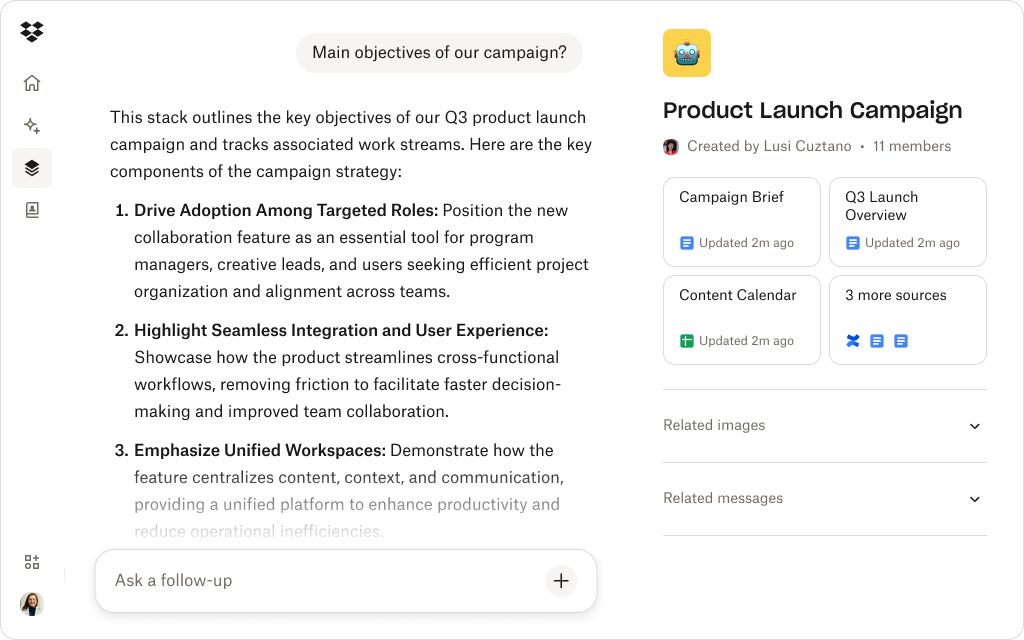
- Bring project materials into Stacks: Stacks provide a way to organize collections of files into lightweight hubs for campaign assets—briefs, copy, reference boards, and creative options—making it clear what belongs together and giving everyone a cohesive view of the work.
- Use Dash Chat to clarify direction: If a stakeholder asks “Where did we last explore this concept?” or “What’s the latest product positioning?” Dash Chat can answer based on your securely connected content, helping managers avoid juggling disconnected threads or piecing together history from memory.
- Share drafts via Dropbox links for review: Because Dash sits on top of Dropbox cloud storage, teams can share content cleanly and gather feedback efficiently, keeping approvals focused on what’s current and accurate. It’s easy to share in just a few clicks.
This approach keeps work flowing, even when multiple contributors are involved—turning alignment from a recurring challenge into a built-in part of how campaigns get done.
Strengthen visibility across every campaign with Dash
Marketing teams often struggle because visibility doesn’t scale naturally. Dash brings together the signals, content, and context teams rely on, making daily work easier to track and collaborate on.
With a smart start page, expansive universal search, and AI-driven insight from Dash Chat, marketers can see work clearly, guide their teams confidently, and execute faster. Try a demo or contact sales to find out more.
Frequently asked questions



.webp)