
.svg)

.svg)

Fast doesn’t always mean smart—AI briefs can miss the mark without the right context.
Campaign briefs are the backbone of every creative project. They distill goals, insights, and strategy into one clear direction. But with the rise of AI tools, many teams are now asking: Can AI write our campaign briefs for us?
The promise is tempting. Type in a few details, and an AI brief generator produces a neatly formatted plan within seconds. But what looks efficient on the surface can quickly backfire when the output lacks depth, nuance, or brand alignment.
Because when insight turns into automation, the strategy that makes campaigns effective disappears. AI can move fast—but without the right context, it rarely moves in the right direction.

Why campaign briefs are harder to automate than they look
When insight turns into checklists, campaigns lose the spark that connects data to emotion.
A great campaign brief isn’t just a checklist—it’s a translation of insight into action. It connects audience insight, competitive positioning, and creative ambition into one narrative that inspires a team to move together.
AI struggles with that complexity. Without access to the right context or tone, AI-generated briefs often:
- Overlook nuanced audience insights
- Misinterpret brand tone or voice
- Miss the strategic reasoning behind past campaign decisions
- Deliver generic, surface-level summaries that lack actionable focus
When speed takes priority over understanding, teams risk spending more time fixing the brief than executing it. Great briefs balance logic and emotion—something AI still can’t fully replicate.
The risks of relying on AI for strategic or creative briefs
AI can accelerate brainstorming—but it can’t replace the judgment or experience that makes a brief effective.
Relying too heavily on an AI brief generator can introduce several risks:
- Shallow insights—AI tools often pull from generalized datasets, not your team’s proprietary knowledge
- Off-brand messaging—without consistent input, tone and phrasing can drift from your established identity
- Inconsistent quality—each user’s prompt produces a different result, leading to confusion and rework
- Data privacy concerns—sensitive campaign information may be exposed when using public AI platforms
AI is powerful, but it needs direction—and that direction comes from structure, context, and human oversight.
How missing context leads to shallow, off-brand outputs
Imagine briefing an AI on “a product launch targeting small business owners.” Without access to real customer data, prior campaign results, or creative guidelines, the model might generate something polished but empty: generic goals, recycled language, and a one-size-fits-all plan.
This lack of context creates three core issues:
- No strategic grounding: The AI can’t reference prior learnings or brand history.
- Disconnected assets: Generated briefs don’t link to creative or research files already on hand.
- Repetitive results: Without institutional knowledge, every new AI draft starts from zero.
Good campaign briefs rely on memory—organizational, creative, and strategic. That’s exactly where connected tools like Dropbox Dash makes AI work smarter.
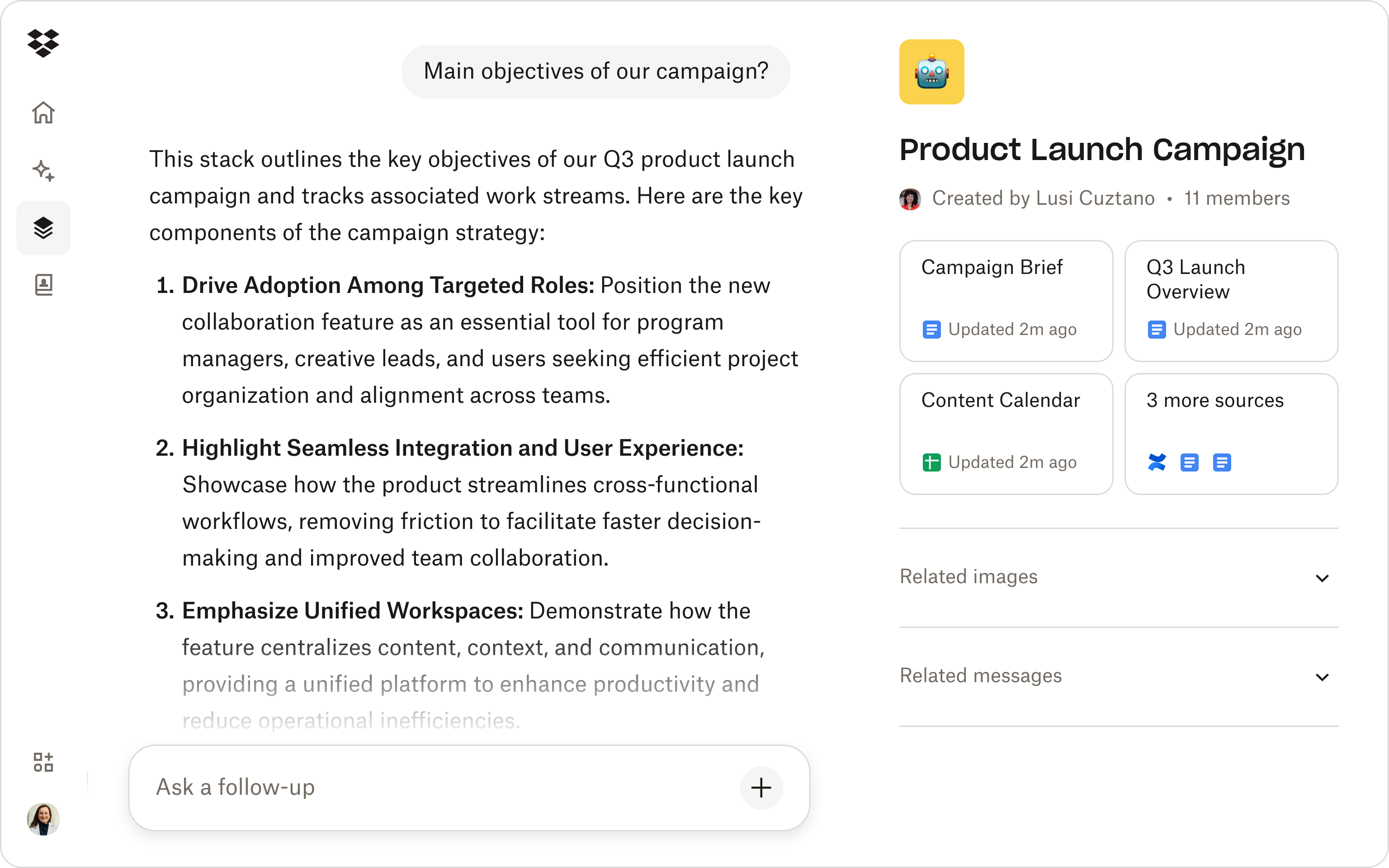
How Dropbox Dash reduces the risks of AI-generated briefs
Dash helps teams mitigate the biggest risks of AI-generated campaign briefs—giving every draft the context, accuracy, and consistency that AI alone can’t deliver.
Restore depth to shallow insights
The Dash AI-powered universal search tool pulls in past briefs, performance data, and research from across your connected apps. Instead of guessing, AI starts from the knowledge your team already has—so outputs reflect your actual strategy, not generalized information.
Keep every message on brand
With Dash Stacks, teams can organize approved assets, guidelines, and creative examples in one place. When AI has direct access to your tone and visual language, every draft stays consistent with how your brand actually sounds.
Build structure into collaboration
Dash Chat lets teams collaborate with AI more intentionally. It can summarize past campaigns or surface key learnings from your files—helping humans focus on judgment, storytelling, and clarity while AI handles the heavy lift.
Protects proprietary data
Dash runs on the same trusted security framework as Dropbox, maintaining your existing permissions and encryption standards. That means your assets, prompts, and feedback remain private, compliant, and fully under your control.
When AI is powered by Dash, every brief starts informed—not from scratch. You get the speed of automation with the strategic depth of human insight—turning AI from a risk factor into a creative advantage.
See how Dash connects strategy into creative results
Dash combines universal search, Dash Chat, and Stacks to help teams create campaign briefs rooted in real brand insight.
Best practices for combining AI speed with human strategy
The goal isn’t to slow down AI—it’s to guide it. Because when context drives creativity, every campaign starts stronger—and stays true to its purpose.
These five practices keep speed and strategy in sync:
- Start with strong prompts: Provide AI with specific objectives, audience details, and tone preferences before generating a draft.
- Pull from existing work: Reference past campaign files through Dash to keep messaging consistent.
- Review strategically: Use AI for first drafts but apply human judgment for refinement and storytelling.
- Centralize your materials: Store brand guidelines, research, and briefs in Dash Stacks to ensure every iteration stays connected.
- Document learnings: After each campaign, upload key insights back into Dash so future AI-assisted briefs can build on proven success.
When AI is trained on your context and refined by your judgment, it stops guessing—and starts collaborating. AI speed plus human strategy equals campaigns that move faster—without losing impact.
Write smarter campaign briefs with Dropbox Dash
AI has changed how quickly teams can move from concept to campaign—but creativity still requires context. Dropbox Dash bridges that gap, connecting assets, documents, and insights that make AI-generated briefs smarter, not shallower.
With everything in one searchable workspace, teams can move from draft to direction faster—without sacrificing authenticity or depth.
See how Dropbox Dash makes speed smarter—connecting strategy, context, and creativity in every campaign brief. Try a demo or contact sales to get started.
Frequently asked questions



.webp)