
.svg)

.svg)

AI shouldn’t just feel helpful—it should prove it. Here’s how to measure the results.
Marketing teams are under constant pressure to do more with less: more content, more personalization, more speed—often with smaller budgets and leaner headcounts. AI promises to solve that. But after the first few months of experimenting with tools and prompts, one question lingers: Is AI actually making us more effective?
For leaders, intuition isn’t enough. The real test of AI’s value lies in measurable results—time saved, projects accelerated, and creative energy reclaimed. Teams don’t just need to feel faster—they need proof.

Why proving AI’s impact matters now
AI adoption is now mainstream—but measurement still lags behind. Most organizations are using AI somewhere in their operations, yet few can prove what that investment is worth.
According to McKinsey’s ongoing State of AI research, nearly 70% of organizations have adopted AI in at least one business area—but many still struggle to quantify its value.
That disconnect between adoption and evidence is where marketing teams often stumble. Without metrics, AI looks like a trend, not a transformation. Proving impact means showing clear outcomes—less manual work, faster campaign delivery, and tangible ROI.
Where time really gets lost in creative workflows
Before measuring improvement, you need to know where time disappears. For many marketing teams, the biggest productivity leaks happen here:
- File retrieval and verification—team members spend minutes (that add up to hours) searching for assets or confirming what’s final
- Manual meeting recaps—turning notes into action items still falls to individuals, even with shared docs
- Duplicated work—designers or copywriters redo what already exists because assets aren’t discoverable
- Slow handoffs—every stage of the process—from ideation to delivery—slows when information is buried in different tools
Those invisible delays are where AI’s true ROI hides—until a system like Dash reveals them. Dropbox Dash eliminates those barriers by using AI to organize and connect every stage of your creative process—so the real value isn’t theoretical, it’s measurable.
The real difference between AI hype and measurable value
Hype fades fast when results aren’t measurable. To turn AI from experiment to advantage, marketing teams need proof—data that connects directly to how work gets done.
Many AI tools promise “productivity,” but what does that actually mean in practice? In marketing and creative work, impact is only real if it can be measured across three areas:
- Time saved—reducing manual work—searching for files, writing recaps, or reformatting assets
- Quality improved—fewer errors, more consistent output, and stronger creative alignment
- Speed increased—faster delivery of campaigns, approvals, and iterations
Dash makes all three measurable because it sits at the center of how work happens—where files live, where teams communicate, and where campaigns take shape.
Key metrics that show the impact of using AI in marketing
If your team wants to prove that AI works, start with data that connects directly to your workflows. These metrics don’t just measure efficiency—they reveal how AI changes the way work actually gets done.
Here are the most useful metrics to track:
- Search and retrieval time: How long does it take to find the right file, deck, or brief? Dash universal search surfaces assets across Dropbox, Slack, and Google Drive in seconds.
- Approval cycle time: How many rounds or days does it take to finalize content? Dash Chat summarizes feedback threads and highlights unresolved comments to accelerate sign-off.
- Campaign launch speed: How quickly can a project move from idea to launch? Dash Stacks organize creative files, data, and decisions in one workspace—cutting prep time.
- Tool-switching frequency: How often do team members switch between apps? Centralizing content in Dash reduces mental overhead and context switching.
- Error reduction: How many revisions stem from version confusion? Dash ensures everyone works from the latest file and approved copy.
When you track metrics like these, impact becomes visible. You see where hours are gained, friction disappears, and campaigns move from concept to completion faster than ever.
Practical ways to track AI performance and ROI
Implementing AI is only the first step. To make a real business case for it, you need proof that it’s driving measurable impact.
When performance data becomes part of your process, it’s easier to show stakeholders that AI isn’t just saving time—it’s reshaping how work gets done.
Here’s how to build measurable visibility into your results:
- Set baselines: Measure how long common tasks—like content reviews or file searches—take today.
- Track improvements weekly: Use activity insights or campaign timelines to see how time per task changes.
- Monitor qualitative gains: Track feedback from creative teams and clients—are deliverables more consistent or aligned?
- Compare project velocity: Use campaign data to calculate how much faster you move from idea to delivery after AI adoption.
- Report results visually: Dash Stacks help you make it easy to show progress over time—connecting saved time, improved outcomes, and creative throughput.
When AI performance becomes visible, it becomes actionable. Teams can pinpoint where automation is paying off, prove ROI in real terms, and use that momentum to scale smarter across the organization. With measurable visibility, AI stops being an experiment—and starts being an engine for growth.
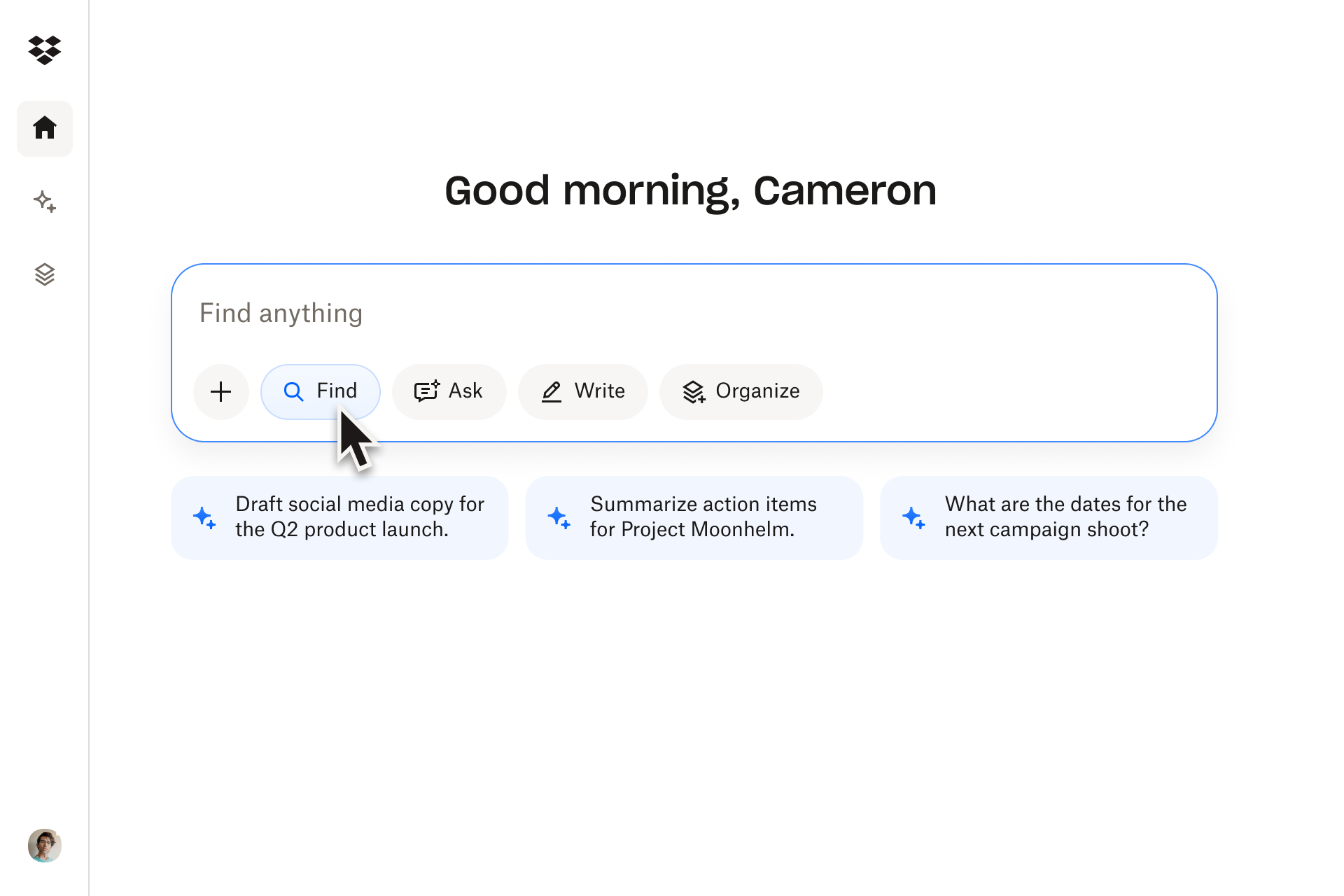
How Dropbox Dash makes AI productivity measurable
Dropbox Dash doesn’t just make AI faster—it makes its impact visible.
Dash is where marketing teams can finally quantify the real impact of AI—not in abstract ideas, but in time saved and campaigns accelerated.
Universal search that saves hours
Instead of sifting through scattered folders, the Dash AI-powered universal search finds what you need fast, across Dropbox, Google Drive, Slack, and more. When finding a file goes from five minutes to five seconds, the ROI speaks for itself.
What this improves—search efficiency and time-to-information
What to measure—average time spent locating files, number of searches performed, time saved per search
How to measure it:
- Run a 1–2 week baseline—have staff log approximate time spent searching for files manually
- After enabling Dash, ask the same team to log each time they use universal search, or use a simple survey asking “How long did it take to find what you needed?”
- Compare averages to estimate hours saved weekly or monthly
For example:
- A campaign manager can instantly pull the latest brief from Dropbox instead of digging through old Slack threads
- A designer can locate a specific version of an image by describing it—no need to remember the filename
Dash Chat for faster collaboration
Dash Chat summarizes notes, pulls key feedback, and helps draft responses based on your actual content. It doesn’t just assist—it removes bottlenecks, shortening review cycles and getting campaigns approved faster.
What this improves—review-cycle length, coordination time, and drafting speed
What to measure—time to produce summaries, number of review rounds, hours saved drafting responses
How to measure it:
- Track how long summaries or recaps take manually vs. using Dash Chat
- Monitor average number of revision rounds before approval before and after using Dash
- Ask teams to record time spent producing first-draft responses with/without Dash
See it in action:
- Summarize a week’s worth of creative feedback into one tidy overview
- Generate a first-draft response to client comments, based on past campaign context
Stacks for structured progress tracking
Organize campaign assets, creative briefs, and reports in Stacks. You’ll see your grouped content all in one view—making before-and-after comparisons easy.
What this improves—project visibility, alignment, and asset retrieval time
What to measure—time spent gathering campaign materials, consistency of asset usage, stakeholder alignment
How to measure it:
- Track time required to prepare a campaign handoff or review before and after Stacks
- Survey stakeholders, by asking “Did you find what you needed in one place?”
- Count the number of links/files shared before Stacks vs. after (it should drop dramatically)
Teams use Stacks to:
- Track how assets evolve from draft to final
- Store performance reports alongside campaign deliverables for quick reference
- Share a single, structured hub with stakeholders instead of multiple folders and links
Dash doesn’t measure ROI for you—but it makes the impact of AI impossible to miss in day-to-day work. When teams spend less time on unproductive tasks, the benefits show up naturally in increased efficiency.
You don’t need dashboards to see the difference—you feel it in how quickly workflows progress and how much creative energy returns to your campaigns.
Dash brings AI into the tools marketing teams already use, so improvements show up in your workflow—not in a separate system.
Do more in less time with Dropbox Dash
Dash connects your tools, surfaces the right content instantly, and helps teams work faster with AI-powered search and summaries.
Turning time saved into creative speed and strategic growth with Dash
Dropbox Dash makes that shift possible by automating the repetitive parts of marketing while giving leaders visibility into how those efficiencies translate into business results.
Dash connects the dots between AI efficiency and measurable marketing results—so you can show time saved, output improved, and campaigns shipped faster. When you can show how much faster campaigns launch—and how much time your team gets back—you prove that AI isn’t just an experiment. It’s an accelerator.
See how Dash helps teams turn AI promise into proof—try a demo or contact sales.
Frequently asked questions



.webp)