
.svg)

.svg)

What if forgotten campaigns were a question away—ready for AI to surface?
Every marketing team has moments where the past could have saved the present. A campaign starts, ideas begin flowing, and someone asks, “Didn’t we try something like this last year?” Heads tilt. People search folders. Someone vaguely remembers a deck. Another thinks the insight may have lived in a document that’s now disappeared.
Campaign history evaporates quietly—not because it wasn’t valuable, but because it wasn’t captured in a way that teams could rediscover. Without a clear record of what worked, what didn’t, and why decisions were made, teams lose institutional memory and often rebuild strategies they already solved.
Dropbox Dash helps change that. By using AI to surface and summarize historical campaign content, Dash gives marketers access to the history they already created—so they can build forward instead of trying to understand the past.

Why campaign history disappears
Campaigns generate a huge amount of work—briefings, insights, scripts, assets, explorations, approvals, and post-launch reflections. But once the campaign goes live, that content gets scattered or archived without a system for reuse. Here’s how history breaks down:
- Work lives across tools: A strategist drafts messaging in a document, a designer iterates in multiple versions of a file, and a project manager keeps notes in chat threads. None of it gets woven together.
- Knowledge walks out the door: When someone moves teams or leaves the company, the reasoning behind decisions often goes with them.
- Early explorations get buried: Some of the best thinking happens in early drafts, brainstorm boards, or alternative directions that never make it to the final round.
- Teams document the “what” but not the “why”: A final deck may contain finished messaging or visuals, but rarely the thinking that shaped them. That thinking should be built upon instead of repeated.
- Campaign wrap-ups lack a connective tissue: Marketing teams may store decks and files, but not in a way that makes the insights searchable or easy to reference for the next campaign cycle.
When teams forget their own creative evolution, the next campaign misses out. The goal is retrievable context—so the every campaign starts with momentum. When teams can quickly reconnect decisions, drafts, and learnings to the assets they produced, campaign history stops being archive material and starts becoming fuel for what’s next.
What gets lost when campaigns wrap
After every launch, the team exhales—and then pivots to the next thing. The files may still exist, but the meaning around them—why choices were made, what was tested, or what was learned—simply gets left behind.
When campaign history isn’t preserved, teams lose more than files—they lose momentum. This means:
- Messaging rationale disappears—a line gets rewritten or reconsidered, but the discussion that shaped it isn’t captured
- Audience insights fade—why one audience resonated with a concept, and another didn’t, becomes harder to recall
- Visual reasoning becomes unclear—designers may remember which concept won, but not why that direction outperformed the others
- Past learnings don’t compound—teams repeat experiments, revisit discarded options, or re-evaluate decisions that were resolved years ago
- New hires start flat-footed—a marketer joining the team has to recreate the brand’s story from fragments rather than building from a cohesive history
This is why teams rebuild instead of just refining. And it’s why the strongest teams treat wrap-ups as a handoff—not to an archive, but to a continuous, reusable story that they can pick up and build on next time.
How AI can restore missing context
When campaign history gets scattered, teams lose the thread—and it all fades away. AI helps rebuild that thread by reconnecting the pieces your team already created, so past work becomes usable again.
Here’s how AI closes the gap between what teams produced and what they can remember or find:
- AI can surface hidden connections—if a marketer searches for “messaging ideas for wellness personas,” AI can bring forward relevant briefs, drafts, past scripts, or insights, even if the filenames don’t signal relevance
- AI can summarize complex histories—campaigns often have dozens of supporting documents, but AI can pull them together and explain the narrative behind the work
- AI can make early explorations usable again—instead of hiding in forgotten folders, brainstorm directions and unused designs re-enter the creative conversation
- AI can speed up onboarding and strategy—teams can ask for summaries of past campaigns, shifts in positioning, or creative patterns across seasons
The real win from AI is continuity. AI doesn’t replace marketing expertise, it simply strengthens it—by turning your archived files into active memory, so teams can move forward with confidence and avoid starting over.
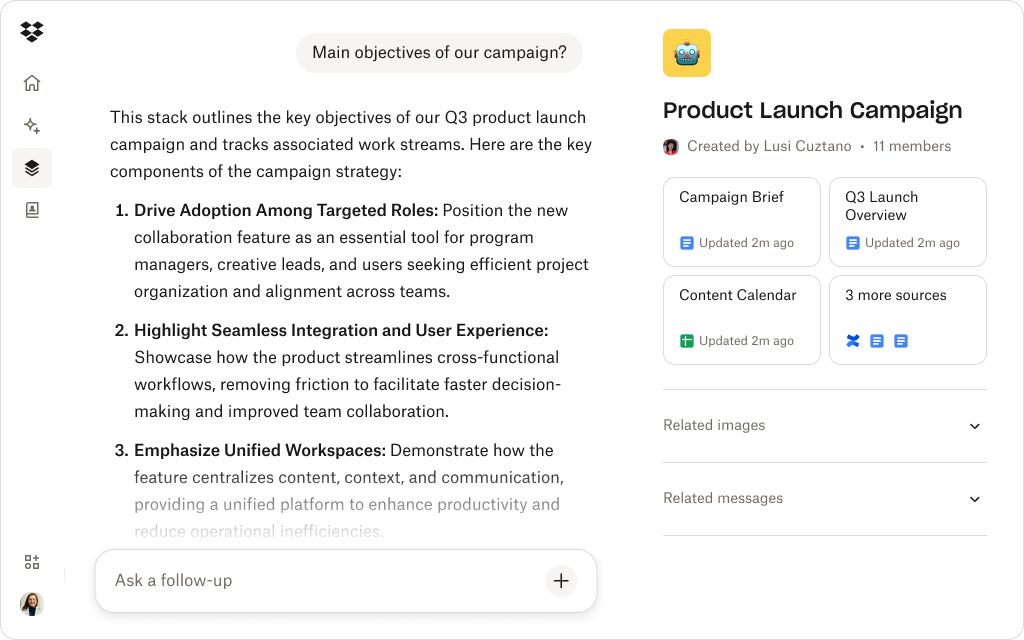
How Dash turns past work into reusable knowledge
Campaign history shouldn’t feel like archaeology. The briefs, iterations, approvals, and post-launch learnings are all somewhere—but when they need excavation from folders and tools, teams default to rebuilding instead of refining.
Dash securely connects your apps and data, making it easy for teams to rediscover campaign history and repurpose it—without heavy process changes. Here’s how it makes past campaigns feel present and accessible:
- Universal search finds meaning, not filenames: Teams can search for themes like “youth messaging”, “holiday offer ideas”, or “sustainability tone”, and universal search in Dash retrieves all relevant content.
- Dash Chat connects history to clear answers: A strategist can ask, “What made our fall campaign successful?”. Dash Chat then summarizes the real files—briefs, creative explorations, scripts, and post-launch notes to provide context.
- Stacks group historical assets into reusable hubs: Teams can build a Stack in Dash called “Brand Refresh History” or “Paid Social Wins,” combining past decks, insights, and creative explorations into one workspace.
- History stays grounded in Dropbox: Dash doesn’t ask teams to reorganize or migrate content. It simply layers context and intelligence on top of the existing cloud storage folder structure.
- Great work becomes evergreen: With Dash, creative thinking that was once lost becomes available to every marketer moving forward. It’s great for fast-moving teams to maintain both speed and efficiency.
The result is a smoother loop from what you learned to what you do next. With a selection of AI-powered features, Dash makes the work reusable—and integrates it seamlessly into your existing workflow.
Help teams rediscover campaign history
Universal search in Dash brings the data and insights that shaped past work to the surface—even when you can’t remember the file name.
A workflow for preserving campaign history
Marketing teams don’t need a system to preserve campaign history—just a smarter way to store and summarize it. Here’s how to build a workflow in Dash that keeps campaigns fresh, searchable, and still meaningful:
1. Store everything in Dropbox, not just the final decks
Briefs, drafts, concept boards, script variations, and moodboards should live alongside final deliverables in your cloud storage, so Dash can later surface the full story—not just the polished ending.
Example: After a product launch, the team saves the original brief, headline routes, and the “why we chose this direction” notes in the same campaign folder—so the next launch doesn’t start from zero.
2. Use Dash Chat to summarize campaign phases
Instead of letting decisions disappear into meetings and threads, use Dash Chat to quickly capture what mattered at each stage—then save those summaries where the team can reuse them. Teams can document:
- The strategy behind the campaign
- Audience insights
- Creative themes
- Key learnings
- Why certain directions were chosen
These summaries then become onboarding gold.
Example: After the mid-campaign check-in, a manager asks Dash Chat, “Summarize what changed since kickoff and why”, then drops the recap into the campaign Stack so stakeholders stop re-litigating old decisions.
3. Build a Stack for each major campaign
Create one Stack that gathers the campaign’s core materials in a clean, referenceable hub—so campaign history stays connected instead of scattered. A single Stack can hold:
- Messaging
- Visual direction
- Selected and unselected concepts
- Performance reflections
Over time, it becomes a living knowledge hub that your team actually returns to.
Example: A global brand team creates a “Holiday Launch” Stack and shares it with regional marketers, so every market starts with the same approved message pillars and creative routes.
4. Reference historical summaries in new brainstorms
When kicking off a new campaign, start by asking Dash Chat to pull forward what you already learned—so ideation begins with momentum, not guesswork. Try asking:
- “What themes did we explore last time?”
- “What messaging approaches performed best?”
- “What creative direction did we refine away from?”
AI can then give marketers instant context that helps push ideas forward.
Example: In a Q2 planning session, a strategist asks, “What objections came up in last quarter’s campaign feedback?” and uses the answer to shape a sharper creative brief.
5. Add new insights after every campaign
Treat wrap-up as an upgrade. Instead of a dusty old archive, take the opportunity to add insights and refine the Stack, add performance notes, and generate an updated summary, so history evolves—rather than resets.
Example: After final reporting, an analyst drops the results deck into the Stack and asks Dash Chat for “3 learnings and 3 next steps”, giving the next campaign team a clear idea for their starting point.
Done consistently, this workflow helps turn campaign history into ongoing strategic intelligence—so every launch starts smarter, tighter, and more aligned than the last.
Build lasting marketing intelligence with Dash
Campaign history shouldn’t disappear into folders no one opens. When teams can surface the insights, reasoning, and creative evolution behind past campaigns, they make sharper decisions—and can avoid starting from scratch.
Dash uses AI to connect your long-term stored content with the team’s current creative thinking, helping turn forgotten work into guidance for tomorrow’s campaigns. Try a demo or contact sales to find out more.
Frequently asked questions



.webp)