
.svg)

.svg)

You’ve spent weeks perfecting a campaign, only to find outdated logos in the final ad.
It’s a small mistake that makes a big impression. Unfortunately, when multiple teams touch the same campaign, brand consistency can slip fast.
Every creative team has a shared goal—to stay aligned and on-brand across every channel, campaign, or deliverable. But when assets live across multiple tools and drives, even the best-organized teams can lose track of what’s current, approved, or final.
It only takes one outdated logo or mislabeled file to throw a campaign off-message—or worse, into frustrating rework. Teams waste time double-checking folders, asking what’s final, or recreating assets they can’t find.
Dropbox Dash gives creative teams confidence and clarity in their work. By surfacing approved assets, relevant context, and past versions across all connected tools, Dash helps teams move faster and stay on-brand.

Why brand consistency slips as creative teams scale
Every great brand is built on a clear, unified story. But as teams grow and campaigns multiply, that story can start to blur. The issue is losing creative cohesion. When designers, writers, and marketers no longer share the same visibility into brand context, alignment slips.
And when creative alignment slips, brand storytelling suffers. Each inconsistency chips away at the brand’s identity—what was once a confident, recognizable voice starts to sound fragmented across channels. This often means:
- Messaging becomes uneven
- Visuals lose impact
- Emotional resonance lowers
This pulls at the threads that tie campaigns together, which results in the whole thing beginning to fray.
The challenge is staying aligned. As teams expand, maintaining creative cohesion requires shared visibility and context. Without it, teams can unintentionally pull in different directions, creating noise instead of narrative.
Maintaining alignment at scale means ensuring every designer, writer, and marketer can see and work from the same creative truth—something only connected systems like the AI-powered features in Dash make possible.
By centralizing creative context and brand assets, Dash helps teams move as one, keeping every campaign and story consistent.
The hidden costs of scattered or outdated creative assets
Creative confidence thrives on clarity—knowing the work you’re building from is the right version, the right message, and true to the brand.
However, when assets are scattered across tools or stored in outdated folders, that confidence starts to erode. Teams hesitate, question what’s current, and lose creative momentum. The result is slower production and work that feels uncertain, inconsistent, and off-brand.
When creative alignment slips, output quality suffers. Over time, small inconsistencies occur, such as:
- A slightly off-tone headline
- An old visual reference
- Outdated product references
These aren’t a big deal individually, but they compound. Over time, what was once a bold, unified brand begins to feel diluted. Instead of pushing creative boundaries, teams second-guess the basics and each new brief feels more like recovery than explanation.
According to the Harvard Business Review, 62% of leaders say generative AI will fuel creativity by automating repetitive tasks, freeing employees to focus on more creative work.
That principle applies to creative asset management too. When teams can instantly locate approved files and understand their context, they spend less time chasing links and more time refining ideas.
Dash brings that freedom to life. Its universal search and AI summaries in Dash Chat reduce repetitive searching and approvals, while Stacks help organize creative assets and brand guidelines in one place.
Why traditional asset management systems fall short
Traditional asset management has always been built around control—keeping files organized, approved, and stored. But in the age of AI and ever-evolving creative collaboration, being “on-brand” means more than organization.
Instead, it means alignment on key branding considerations such as:
- Shared tone
- Consistent storytelling
- Coherent messaging
Overall, being on brand is about creating a unified understanding of what the brand feels like.
The problem with legacy systems is that they can’t preserve the why behind it. They manage assets, not meaning. When creative teams can’t see the tone, intent, or feedback that shaped an idea, messaging starts to drift.
You’ve probably seen copy from brands that’s technically correct but emotionally inconsistent—a campaign that hits the brief but misses the brand. In modern creative environments, these gaps show up fast in the form of:
- Disjointed tone—campaigns sound different across regions or teams because voice and context aren’t shared alongside the assets
- Message misalignment—files are stored, but their story gets lost, which means teams reuse assets without understanding the strategy behind them
- Fragmented storytelling—design and copy evolve separately, breaking the emotional thread that makes brands feel cohesive
- Creative hesitation—without clear reference points, teams spend more time questioning what being on-brand means instead of creating it
Traditional systems may solve where things are, but they don’t solve who you are. Dash bridges that gap, bringing creative context into every asset—connecting tone, intent, and feedback to the files themselves.
In Dash, assets live together, as part of the same story. It helps teams stay creatively coherent, ensuring that every campaign, caption, and visual speaks with one unified voice.
How Dropbox Dash gives teams instant access to approved assets
The hunt for the right file wastes time and chips away at creative confidence. Between multiple touchpoints and inconsistent folders, even the most organized teams struggle to find what’s current, approved, or final.
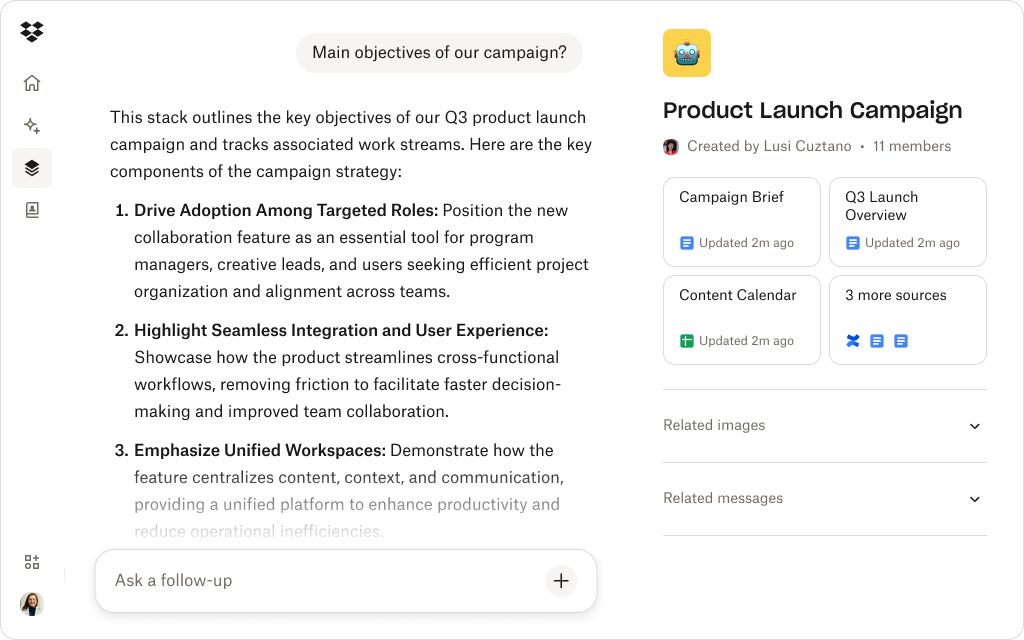
Dash changes that by transforming asset management into an intelligent, connected workspace where alignment happens automatically. Here’s how Dash helps teams stay organized, confident, and on-brand:
- Find what’s final faster: AI-powered universal search in Dash connects data across Dropbox, Google Drive, Slack, and more to surface every relevant file, comment, or thread—along with ownership, version, and status. You see the approved asset instantly and avoid guesswork.
- Understand context instantly: With Dash Chat, teams can summarize file details, review feedback threads, and confirm approvals in seconds. Ask “Which logo version was approved last week?”—and Dash gives an instant, accurate answer. You can even use writing capabilities in Dash Chat to draft new copy based on tone guides.
- Keep teams aligned effortlessly: Stacks allow teams to group brand guidelines, design templates, and final assets into organized collections. Whether you’re in marketing, design, or copy, everyone can work from one organized Stack—staying aligned, no matter the time zone or team size.
- See the story behind every asset: Dash helps you understand why a file matters. Connected apps provide this context and Dash learns how assets fit into campaigns, who updated them last, or where they’ve been used. This gives teams confidence they’re building from the right creative source.
Together, these capabilities give teams a single place where direction stays clear and brand identity stays intact.
With Dash, finding what’s final becomes effortless—and staying on-brand becomes second nature. It’s not just file management; it’s creative alignment in motion.
Find the right file faster
Universal search in Dash connects all your tools—so teams can instantly find, verify, and use approved creative assets with confidence.
Best practices for keeping creative collaboration aligned
Even the best tools can’t fix disorganization on their own—because brand consistency starts with behavior.
As creative teams grow and projects multiply, maintaining order depends on shared habits. Dash makes these workflows easier, but it’s the daily discipline of teams that keeps creativity consistent and collaboration seamless.
Dash supports these habits automatically, but to get the most from Dash and your creative asset workflow:
- Create one source of truth—store all approved assets in Dash-connected folders or Stacks to avoid duplication.
- Add context, not clutter—use Dash Chat to summarize why assets exist and how they should be used.
- Define approval workflows—make sure final assets are clearly tagged or linked to their sign-off threads.
- Audit regularly—clean up outdated assets (at least quarterly) to ensure only the latest versions circulate.
- Educate your team—encourage everyone to use universal search before creating or reusing materials.
Small habits, scaled across teams, work to preserve brand trust and creative efficiency. Dash gives those habits a creative hub—connecting every file, comment, and approval in one workspace that keeps creative assets organized.
Creating brand alignment that lasts with Dropbox Dash
By connecting data across every tool, Dash transforms creative asset management. Whether it’s a global rebrand or a seasonal campaign, Dash ensures your creative direction stays consistent, connected, and confidently on-brand.
Dash helps creative teams find approved assets, confirm context, and stay on-brand across every campaign. See how Dash keeps creative teams aligned—no matter how fast you scale. Try a demo or contact sales to get started.
Frequently asked questions



.webp)