
.svg)

.svg)

Align how your team uses AI—so every output sounds smart, on-brand, and consistent.
AI tools are now part of daily workflows—from drafting copy to organizing data—but that doesn’t mean everyone uses them the same way. Some team members experiment freely, while others avoid them altogether. The result is uneven output, off-brand tone, and missed opportunities to scale what works.
This inconsistency is a literacy issue. AI literacy is about more than knowing which tools to try. It’s about using them responsibly, collaboratively, and in ways that support shared goals.
To build that literacy, teams need a reliable place to capture what works: the prompts that perform, the tone that fits, the standards that hold everything together. Centralized knowledge and standardized ways of working turn AI from trial and error into a consistent, trusted part of everyday work.
When teams develop a shared understanding, AI stops feeling experimental and starts becoming a source of alignment and scale.

Why AI literacy matters for every team
AI literacy has quickly become as essential as digital literacy. Creating a shared foundation helps teams move from scattered experiments to intentional innovation.
Managers and team leads can help by encouraging people to:
- Understand what AI can and can’t do—avoid unrealistic expectations or overreliance on automation
- Use AI consistently—align tone, structure, and output quality across departments
- Evaluate AI critically—ensure the team can identify bias, misinformation, or irrelevant results
- Collaborate with context—connect AI-generated ideas to existing projects, not isolated outputs
Without shared understanding, even the best tools create friction instead of flow. AI literacy ensures creativity scales responsibly—without losing brand voice or human oversight.
The risks of inconsistent AI use in organizations
AI can boost productivity, but uncoordinated adoption introduces new challenges.
When everyone uses AI differently, collaboration suffers and quality control becomes nearly impossible. It’s easy to imagine: marketing, support, and product teams all using AI to communicate—one for product copy, another for customer outreach—and the results sounding nothing alike.
Without shared standards, what starts as innovation can sound disjointed, and efficiency quickly turns into inconsistency.
Common signs of low AI literacy include:
- Inconsistent tone or messaging—teams produce off-brand content or contradictory outputs
- Lost knowledge—prompts and techniques live in private documents or personal accounts
- Rework and redundancy—employees repeat experiments others have already solved
- Data exposure risks—without guidance, sensitive information can accidentally be shared with external tools
Without structure, every experiment becomes a silo—and valuable insights never scale.
What effective AI literacy training looks like
Successful AI literacy training goes beyond tutorials or tool demos. It builds a foundation for shared understanding and safe experimentation.
Training shouldn’t just teach tools—it should build shared judgment. The goal isn’t to create AI experts, but confident collaborators.
The best AI training programs include:
- Clear goals: Define how AI fits into your team’s strategy—whether it’s speeding up reporting, ideation, or customer support.
- Hands-on practice: Let teams test real use cases that mirror their day-to-day responsibilities.
- Prompt libraries: Create a shared library of successful prompts for consistency and inspiration.
- Ethical guidelines: Reinforce data privacy, tone of voice, and fact-checking standards.
- Feedback and iteration: Review results regularly to refine workflows and evolve best practices.
The goal isn’t compliance—it’s confidence. AI literacy creates a culture of curiosity. When done right, it empowers teams to work faster and smarter—without sacrificing quality or compliance. And with the right tools to capture and share what works, like Dropbox Dash, teams can turn training into everyday alignment.
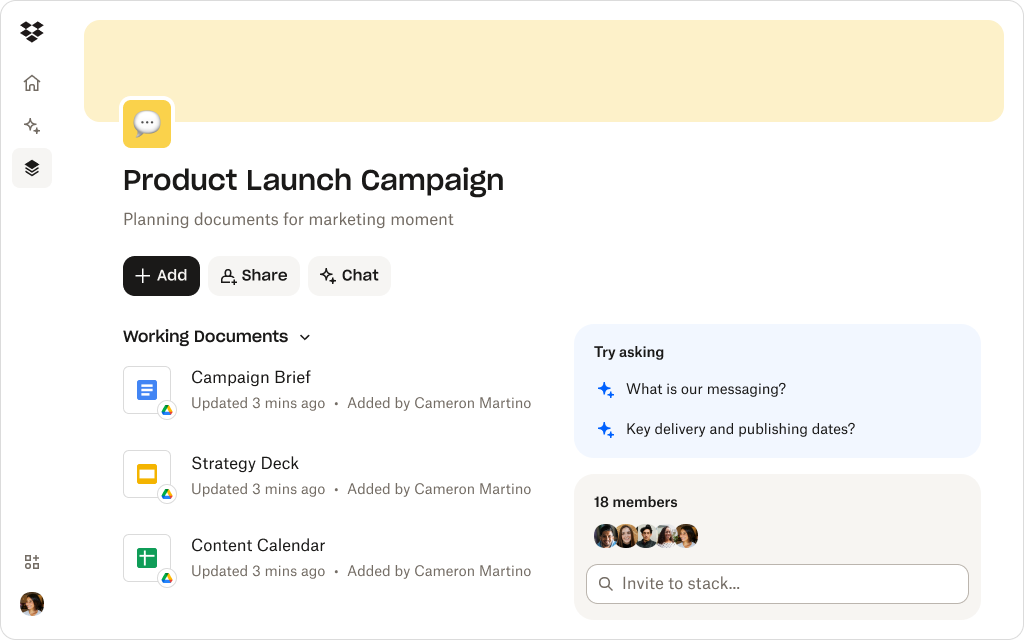
How Dropbox Dash helps teams align on AI usage and standards
Dropbox Dash turns AI literacy from an abstract concept into a practical, daily habit. With its Stacks, universal search, and AI chat features, Dash helps teams document, share, and refine their use of AI collaboratively.
Instead of scattered prompt docs and disconnected experiments, teams get one connected system for learning, applying, and improving together.
Here’s how Dash brings AI alignment to life across the tools your teams already use:
Stacks for shared learning
Teams can use Dash Stacks as AI literacy hubs—organizing prompts, examples, and guidance in one accessible place. Need to find last week’s training deck or a prompt library? Dash’s AI-powered search surfaces it instantly.
Stacks give every team a common foundation: the same playbook, visible to everyone, always up to date. What once lived in private docs becomes shared institutional knowledge. Dash brings together approved materials and insights under one view, while respecting existing permissions, so everyone can find and build on what’s already shared.
Say a new hire joins your marketing team—they can instantly browse your best prompts and brand guidelines in one place, without chasing old links or Slack threads
Universal search for connected knowledge
Dash connects information across Dropbox, Google Drive, Slack, and other tools. That means all AI-related content—from documentation to recorded trainings—is searchable from one workspace.
No more version chaos or forgotten folders—Dash brings every lesson, policy, and example into one searchable context. The result is less time searching and more time scaling what already works.
Need that customer training deck from three months ago? Type a few words, and Dash surfaces it—whether it lives in Slack, Drive, or Dropbox.
Dash Chat for smarter application
When teammates have questions (“What’s our brand tone for social posts?”), Dash Chat can summarize internal best practices or point directly to the right file.
It’s like having a knowledgeable colleague who remembers every approved prompt, policy, and process—making AI guidance feel immediate and actionable.
When someone asks, ‘What’s our tone for product updates?’ Dash Chat can pull the answer from your own materials—no guesswork, no hunting.
Secure permissions and oversight
Because Dash is built on the Dropbox security framework, managers can control who has access to sensitive materials—ensuring that AI training content stays organized and compliant.
That structure keeps experimentation safe and confidence high: teams can explore freely, knowing guardrails are already in place. For example, marketing can refine prompts and test tone variations without ever exposing customer data or internal assets.
With Dash, teams don’t just use AI—they use it together, with shared guardrails, consistent tone, and collective confidence. It turns AI from a personal skill into a team capability—aligning how people work, learn, and create every day.
Create shared spaces for AI learning
Dash Stacks bring prompts, brand assets, and AI best practices together in one secure workspace—so every team stays aligned.
Turning AI literacy into everyday culture
Consistency doesn’t happen by chance—it grows from shared habits, curiosity, and a willingness to learn together. AI moves fast, but teams that evolve together stay confident, creative, and aligned.
To keep that momentum, leaders can:
- Create a shared language: Make sure everyone speaks the same AI vocabulary—terms like “prompt,” “training data,” or “review threshold” shouldn’t feel mysterious.
- Centralize what works: Use Dash Stacks to store prompts, examples, and best practices so hard-won insights never get lost.
- Empower AI champions: Encourage teammates to explore, experiment, and share what they learn.
- Keep the conversation open: Use Dash Chat to surface insights from real use cases and spread them quickly across teams.
- Review and refresh regularly: Check in each quarter to update practices and stay aligned with new tools, standards, and lessons learned.
When teams treat AI as a shared skill instead of a personal shortcut, something powerful happens—learning compounds. What starts as training turns into culture.
AI is reshaping how we create, communicate, and collaborate—but only when everyone moves in sync. Without alignment, even the smartest tools can create noise instead of progress.
Dropbox Dash helps teams stay connected as AI evolves. By uniting prompts, training materials, and brand guidelines in one secure workspace, Dash turns scattered learning into a shared foundation. The result? Every output reflects the same confidence, tone, and standard of quality.
AI literacy doesn’t belong to a single team—it’s the new language of collaboration. When your organization builds that shared fluency, AI stops being an experiment and becomes part of how you think, create, and grow—together.
Unify your team’s AI literacy with Dropbox Dash
Every great AI output starts with alignment—the shared understanding of what good looks like. Dash helps teams capture that knowledge and make it part of everyday work.
Dash connects your AI prompts, training, and brand assets in one secure, searchable workspace—so everyone creates with the same clarity and confidence.
See how Dash helps teams align on AI workflows—try a demo or contact sales to get started today. When alignment becomes habit, AI doesn’t just make work faster—it makes it smarter, safer, and more connected.
Frequently asked questions



.webp)