
.svg)

.svg)

AI works best when you know what to ask—here’s how marketers sharpen that skill.
Marketers are turning to AI to work smarter but too often, the results fall flat. The issue isn’t the technology; it’s the conversation. AI can refine copy, compare creative options, or pull insights from performance data, but only when it’s asked the right questions.
That’s where many teams get stuck. Without the right prompts, or access to the right context, AI becomes a novelty instead of an advantage. Dropbox Dash changes that by grounding AI in your real marketing ecosystem like campaign briefs, reports, decks, and messaging docs. With Dash Chat, you can ask natural, plain-language questions and get responses pulled directly from your own materials, not generic content from the web.
The better your questions, the smarter your AI becomes. And when marketers know what to ask, creativity, speed, and strategy all click into place.

Why AI falls short when questions are unclear
AI isn’t a mind reader, it’s a mirror. Whatever you put in, it reflects back. When a prompt lacks direction or context, the result might look polished, but often the outputs are vague, incomplete, or generic.
Here’s some common issues marketers face:
- Weak prompts that lead to generic answers
- Asking AI to “improve this” without explaining the goal
- Leaving out context that changes the meaning
- Asking overly broad questions that produce unusable summaries
- Not specifying the audience, channel, or format
When AI delivers underwhelming output, it’s rarely because the model failed, it’s because the question left too much room for guesswork. The clearer your intent, the closer AI gets to being a true creative partner.
The difference between asking AI for answers vs. outcomes
There’s a subtle but powerful shift between asking AI for information and asking it for impact. The best prompts don’t just look for answers they define the outcome you need. When you start with what you’re trying to achieve, AI becomes far more than a search tool; it becomes a creative partner.
Here’s how that difference plays out:
- If you want data: “Which messages performed best in last quarter’s campaign assets?”
- If you want direction: “What themes should we emphasize for a B2B audience launching a new service?”
- If you want creation: “Draft three headline ideas using our brand tone and the Q4 positioning deck.”
- If you want transformation: “Rewrite this value prop for social rather than long-form copy.”
When your prompt starts with a clear outcome, AI doesn’t just answer questions, it produces work you can use, refine, and build on. That’s how teams turn generic output into meaningful progress.
How marketers can structure questions that lead to useful results
AI becomes dramatically more powerful when you give it the right frame to work within. Instead of treating a prompt like a command, think of it as a brief—a short, structured description of what you’re trying to achieve.
Strong questions include four essential parts:
1. Purpose
Explain what you’re trying to accomplish so AI understands your goal.
- “Help me prepare for a client call…”
- “Summarize this for an internal kickoff…”
A clear purpose helps AI focus its response on the kind of work you actually need done.
2. Context
Reference the campaign, audience, file, or content Dash can draw from.
- “Using our Q2 messaging doc in Dropbox…”
- “Based on last month’s performance report…”
Context gives AI the raw material to build accurate, relevant answers.
3. Constraints
Offer simple guardrails around tone, format, or length.
- “Keep the tone direct and concise”
- “Produce three variations under 20 words”
Constraints steer AI toward usable, brand-aligned results instead of endless options.
4. Action
Tell AI what to do with the information.
- “Translate this insight into a slide headline”
- “Identify gaps we should address”
Clarity in = clarity out. The more precisely you describe your intent, the more precise your AI results will be.
Common question formats that elevate AI responses
Strong prompts don’t happen by accident—they follow familiar patterns that guide AI toward business-ready answers. Marketers who use proven question formats get richer, more actionable output every time.
Comparison questions
“What’s different between these two versions of the campaign brief?”
How it helps: Great for identifying changes, improvements, or inconsistencies.
Decision-support questions
“What key risks should we prepare for in this launch plan?”
How it helps: Use these when you need analysis that helps inform strategy.
Extraction questions
“Pull the top takeaways from this 20-page deck.”
How it helps: Perfect for summarizing dense materials and surfacing what matters
Role-based questions
“As a performance marketer, what would you prioritize in this report?”
How it helps: Helps AI think from the right perspective, not just regurgitate data.
Audience-specific questions
“How should we frame this announcement for enterprise IT buyers?”
How it helps: Ensures messaging aligns with who you’re speaking to, not just what you’re saying.
These formats focus AI’s attention on outcomes that support real marketing decisions to help you get outputs faster.
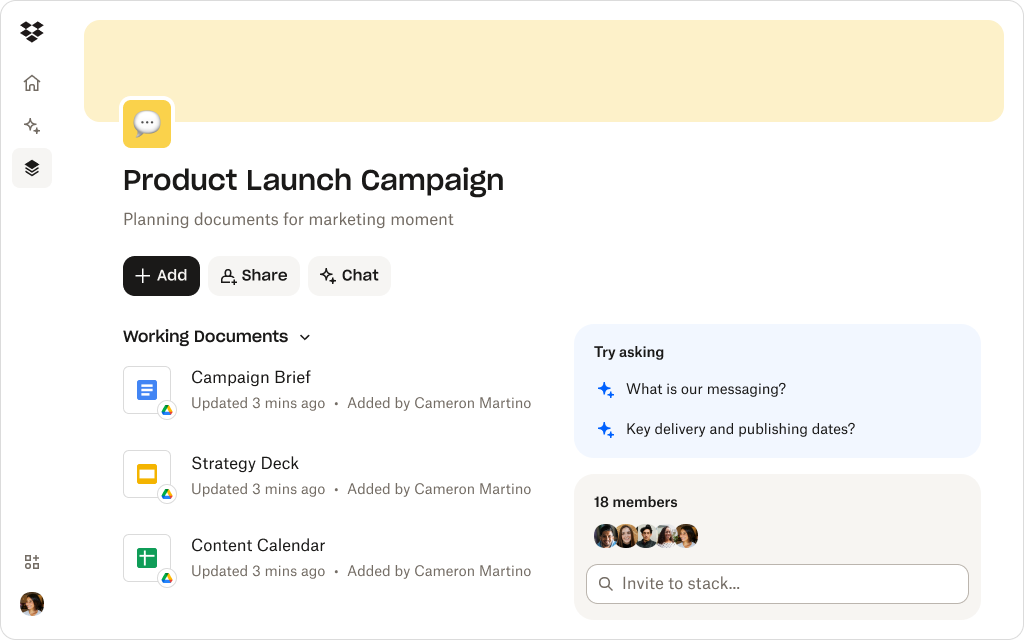
How Dropbox Dash interprets natural-language questions using your real content
Most AI tools search the open internet for answers. Dropbox Dash does the opposite—it uses your team’s own materials, securely stored in Dropbox and connected tools, to deliver context-rich responses grounded in truth.
Dash understands your questions
You can ask natural, everyday questions such as:
- “What should I say in the next client update?”
- “What messaging themes did we use last year for this product?”
- “What’s the most recent version of this asset?”
Dash interprets your intent and pulls from the right files.
Dash finds the right material
Universal search scans across folders, drives, email threads, and connected platforms simultaneously—so the right version is always one search away.
Dash gives context-aware answers
Dash Chat doesn’t just summarize; it interprets. It can compare messaging, rewrite content, or extract insights directly from your team’s approved content and campaign materials.
Dash never overrides permissions
Only files a user already has access to will appear in results, ensuring your data remains secure and compliant.
This is AI that works the way marketers actually work—fast, contextual, and grounded in truth.
See how Dash Chat turns questions into meaningful answers
Dash Chat connects natural-language questions to your team’s real content—delivering answers that reflect your campaigns, strategy, and brand voice.
Practical ways to improve your AI questioning skill
Getting great results from AI is like getting great creative feedback—it’s a skill you can sharpen over time. Here’s how to practice it every day:
- Start with the outcome you want—define whether you’re looking for clarity, a rewrite, an idea, or an explanation before you ask.
- Reference a real file or campaign—Dash performs best when you ground your question in a specific piece of content.
- Ask follow-up questions—iteration builds understanding. Each follow-up helps Dash learn your preferences and refine results.
- Use “why” and “what’s missing” questions—these push AI beyond surface-level summaries and uncover insights you might overlook.
- Combine AI and human judgment—Dash accelerates thinking, but your perspective brings the strategy. The two together turn automation into intelligence.
From uncertainty to clarity: Asking AI with confidence
AI is most valuable when it helps you think better—not just faster. When marketers learn what to ask and how to guide AI toward richer context, it becomes a genuine collaborator that sharpens insights and accelerates creativity, not be just a novelty.
Dropbox Dash makes that possible. By connecting AI directly to your stored content, it helps your team understand, analyze, and act—not just generate.
Ask better questions. Get better answers. Work better, together.
Turn better questions into better work with Dropbox Dash
Dash connects AI with your Dropbox files to deliver clear, context-rich answers—so teams stop guessing and start progressing. Try a demo or contact sales.
Frequently asked questions



.webp)