
.svg)

.svg)

What if AI prompting turned your ideas into faster, smarter marketing wins?
AI has become a powerful creative assistant for marketers—capable of drafting, summarizing, or rewriting content in seconds. But the difference between an average output and a great one often comes down to one thing: the prompt.
Prompt writing is now a skill, not a shortcut. The more specific and connected your prompts are, the more your AI delivers work that sounds strategic, on-brand, and human.
Once you’ve learned how to write sharper prompts, the next step is applying them where they matter—inside your real campaigns. With the right workspace, you can connect campaign files, briefs, and reports across your tools, then refine prompts to summarize insights, spark ideas, and craft on-brand copy that’s ready to launch.
That’s where Dropbox Dash helps—giving marketers a connected space to turn strong prompting into real creative results.

Why prompt skills are the new marketing advantage
AI doesn’t replace creativity—it accelerates it. But to get there, teams need to shift from experimenting with tools to mastering how they ask questions.
A strong AI prompt bridges four things every marketer cares about:
- Clarity—the AI understands what you need.
- Context—it uses relevant background information.
- Consistency—it adapts to your brand voice, tone, and audience expectations.
- Creativity—it carries your unique judgment, taste, and fingerprint as the prompter, turning AI from a utility into a creative multiplier.
For example, instead of asking an AI tool to “write a campaign headline,” a skilled marketer might prompt:
“Write three headline options for a Dropbox campaign targeting creative teams. Keep it under eight words and focus on clarity, organization, and security.”
That single change transforms the result—from a generic headline to one that fits brand tone, audience needs, and campaign strategy.
Prompt skills are fast becoming as valuable as writing or analytics. Marketers who learn to structure inputs effectively will unlock more accurate, nuanced, and impactful outputs.
The problem with trial-and-error prompting
Every marketer has experienced the AI frustration loop: write a prompt, get a generic answer, tweak it, and try again. Without the right data or structure, even advanced models produce safe, surface-level results.
Common issues include:
- Vague direction—prompts like “write ad copy for our product” lack tone or goal
- No brand grounding—AI tools don’t know your existing assets or style
- Repetitive results—generic phrasing and unoriginal ideas creep in
- Time loss—instead of saving time, teams spend it iterating
AI is only as smart as the information it’s given. Dash helps solve this by connecting prompts directly to your organization’s content—turning disconnected experimentation into informed creativity.
What makes a good AI prompt for marketing tasks
A well-crafted prompt doesn’t just tell AI what to do—it teaches it how to think. For marketing work, effective prompts share these traits:
- Defined intent—be clear about what success looks like: “Create a 30-second social caption with a bold opening and a friendly tone.”
- Rich context—include campaign or audience details: “Use insights from our Q3 report on Gen Z engagement.”
- Tone and format guidance—add direction: “Match the tone of our ‘Launch More’ campaign and end with a CTA.”
- Reference material—point AI to what matters: “Reference our brand guide stored in Dropbox.”
- Human fingerprint—add a touch of your own taste, instinct, or creative judgment to guide the output: “Bring in a slightly playful edge—something I’d write myself.”
The key is precision. The more grounded your prompt is in the content and goals that matter, the better the output.
Across teams, strong prompts create consistent results—helping AI understand your brand language as well as your people do.
Essential prompt-engineering skills for marketers
You don’t need to be a developer to master prompt engineering. You just need to practice structured thinking and experiment intentionally.
Here are five practical skills to develop:
- Start with structure: Break prompts into parts—objective, tone, length, and format—to reduce ambiguity.
- Iterate with purpose: Treat each prompt revision like an A/B test: what changed, and what improved?
- Feed your AI facts: Link real data, reports, or campaign files stored in Dropbox and connected apps to ground your request in reality.
- Ask AI to explain itself: Use follow-ups like, “What audience does this copy appeal to?” to understand how the AI interprets your brand.
- Summarize, then expand: Start with Dash Chat summaries of campaign assets or reports, then ask AI to reframe those insights into new creative directions.
When those skills live inside a connected system like Dash, every prompt becomes more than an experiment—it becomes part of a repeatable creative process.
Make every prompt count with Dropbox Dash
Dash connects your AI prompts to real brand assets, creative decks, and campaign data—so your team gets more accurate, on-brand results every time.
How Dropbox Dash connects prompts to real brand context
Dropbox Dash is built for the creative teams who use AI daily. It doesn’t just generate outputs—it grounds them in your existing knowledge base. Here’s how:
Prompts that reference real content
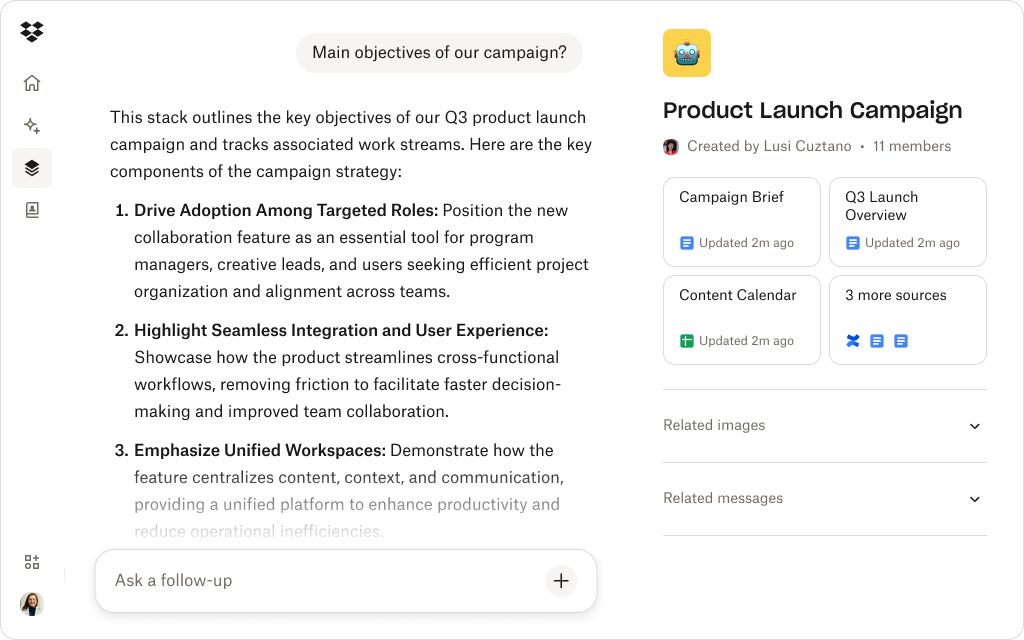
Dash connects to Dropbox and connected apps’ folders, campaign briefs, and creative assets. When you write a prompt in Dash Chat—like “Summarize key takeaways from our last ad performance deck”—AI pulls from the actual file, not a generic dataset.
That means every output reflects your real data, not assumptions—so you get ideas that align with your campaigns, not contradict them. This makes every AI prompt more relevant and reliable, helping marketers create stronger brand-connected content.
AI that understands your goals
Dash learns from the structure of your work. It understands how a product launch deck connects to campaign copy, helping you build prompts that span strategy, storytelling, and performance.
By recognizing these relationships, Dash helps your AI think the way your team does—linking insights, creative, and execution seamlessly. It turns prompting into a strategy tool—not just a writing shortcut.
Creative iteration in context
Because Dash keeps prompts, drafts, and assets in one place, you can refine your ideas without starting over. Revisit earlier prompts, track what worked, and store learnings alongside your campaign files.
It’s a living creative history—one that gets smarter with every iteration and saves your team hours of rework. That means better prompts, faster feedback, and a more consistent creative process every time.
Safe and searchable
Every prompt, output, and connected asset lives securely in Dropbox—governed by existing permissions and version control. That gives teams freedom to explore AI confidently, knowing every file and idea stays protected, organized, and easy to find later.
It’s secure prompting with creative freedom—so innovation never compromises trust.
Dash makes every prompt part of a smarter, faster creative process—one grounded in truth, shaped by context, and ready to deliver results your team can actually use.
Real-world examples of high-performing marketing prompts
To show how context transforms AI results, here are three examples of how marketers can evolve vague prompts into connected, brand-ready ones:
From generic to targeted email copy
- Before: “Write an email about our new product.”
- After: “Summarize the key points from the Q4 product brief in Dropbox and write a short, upbeat email introducing the product launch for social media professionals.”
Connecting the prompt to the product brief gives the AI the tone, audience, and message context it needs—turning a one-size-fits-all draft into a campaign-ready email.
From basic ad copy to brand-aligned headlines
- Before: “Create ad copy for our SaaS tool.”
- After: “Using the approved copy deck in Dropbox, write three headline variations for a LinkedIn campaign targeting creative directors at mid-sized agencies.”
Referencing brand-approved materials ensures the output reflects your existing voice and positioning, rather than the AI’s default phrasing.
From random blog ideas to data-driven content planning
- Before: “Give me blog post ideas.”
- After: “Review last year’s campaign reports in the ‘Trends’ folder and suggest five blog post topics that build on our top-performing content.”
Here, Dash universal search’s ability to surface past performance data gives AI the context to propose ideas that align with proven success—resulting in a smarter editorial roadmap.
When prompts pull from connected files through Dash, AI understands your audience, brand, and creative goals. The result is content that feels informed, relevant, and uniquely your own.
Build confident, creative AI workflows with Dropbox Dash
Dropbox Dash gives teams the foundation to make that happen—combining search, summarization, and connected prompting in one secure workspace. Whether you’re brainstorming campaign angles or rewriting copy, Dash helps you focus less on trial and error and more on outcomes.
Bring your AI tools and marketing content together with Dash—so every prompt, draft, and idea is connected, accurate, and creative. Try a demo or contact sales to see how Dash transforms prompting into performance.
Frequently asked questions



.webp)